
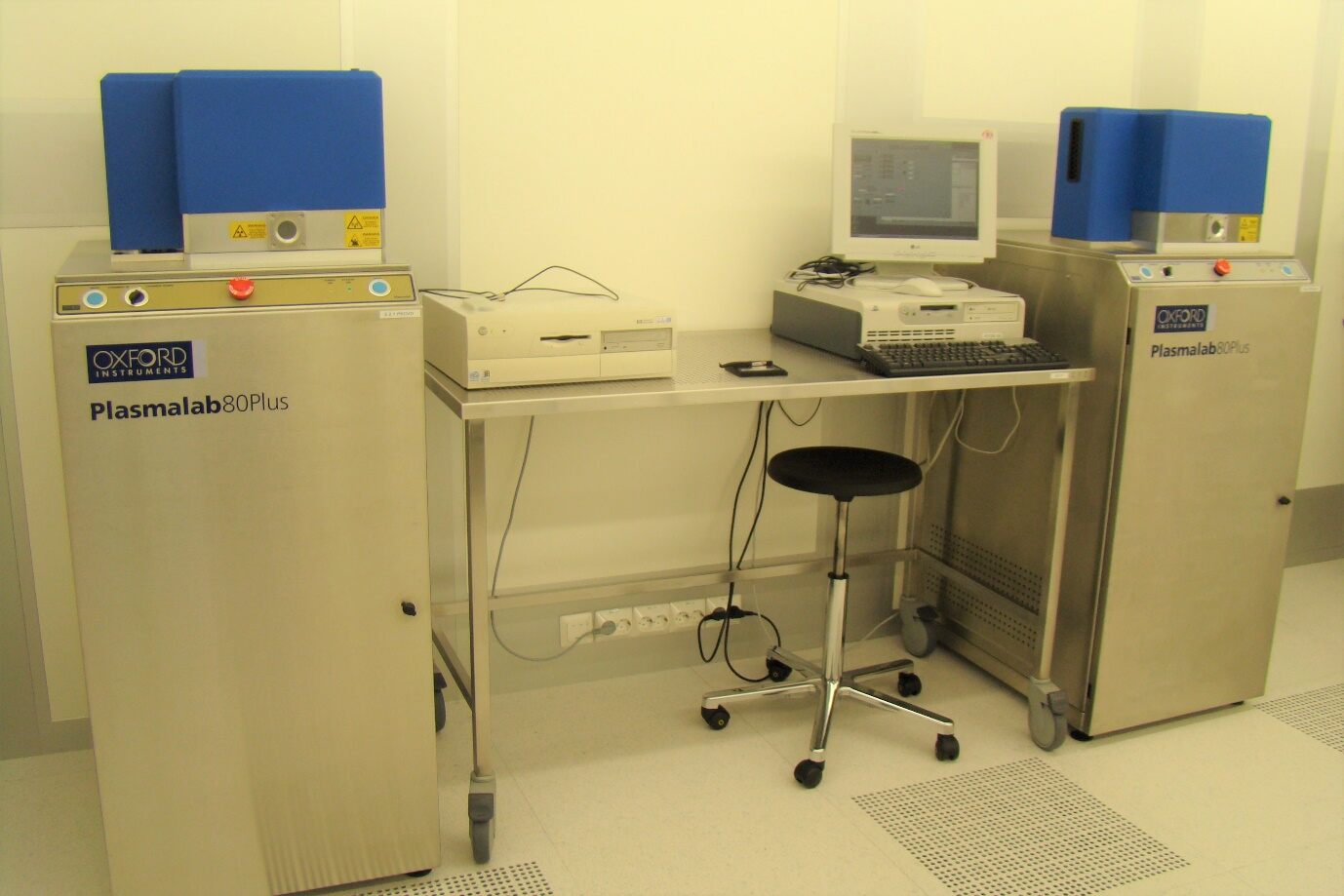
Two Plasmalab 80+ Plasma Enhanced Chemical Vapor Deposition systems (PECVDs) (Oxford Plasma Technology, 2000) are used for thin film growths and plasma treatments. Normal process temperature is 300 °C and the operatable range is from room temperature to 400 °C. The systems are differentiated as ‘left’ and ‘right’ and are dedicated for SiNx and SiO2 growths, respectively. Both systems are capable of depositing both materials and materials can also be used intermixed if necessary. Operating the systems happen mainly by using intuitive GUI.
Details
Location:
Tampere University (TAU), Tampere
Contact person:
Jukka Viheriälä (Tampere)
Info:
Two Plasmalab 80+ Plasma Enhanced Chemical Vapor Deposition systems (PECVDs) (Oxford Plasma Technology, 2000) are used for thin film growths and plasma treatments. Normal process temperature is 300 °C and the operatable range is from room temperature to 400 °C. The systems are differentiated as ‘left’ and ‘right’ and are dedicated for SiNx and SiO2 growths, respectively. Both systems are capable of depositing both materials and materials can also be used intermixed if necessary. Operating the systems happen mainly by using intuitive GUI.
Spesifications
The systems don’t have separate load locks, but loading the samples takes place on the heated process table in atmosphere. Pump down cycles to base pressure are relatively fast (~ 2 min) and the growth rates are 0.3-1.2 nm/s, enabling fast growth of several hundred nanometers thick layers. Film growth is controlled with setting time, so there is no active thickness monitoring involved.
Coating Materials: SiO2, SiNx
Process gases: N2, N2:SiH4 2%, N2O, NH3, (CHF4/O2 as cleaning gas)
Typical substrates: Fused silica, Quartz, BK7, Si, GaAs
Typical coatings: Single-layer films, Hard masks, Anti-reflection (AR) coatings, Passivation layers, Insulating layers
Training Requirements
For a user to get training for PECVDs, they have to have:
- Frequent need (systems should be used regularly in order to maintain the level of competence of the operators)
- Understanding of the basic principles of chemical deposition methods (be aware of the involved process mechanisms)
Not allowed processes
Just to name a few unallowed processes and reasons why they are not usable. Any non-standard process needs approval from the responsible person for the same reasons than listed below.
- No long etching runs: Short plasma processes without growing a thin film are allowed, but longer etching runs will cause contamination.
- Samples that don’t endure the heat (or plastic tweezers for sample handling): primarily the deposition processes require the elevated temperatures for proper film growth, so resists and other plastics aren’t suitable in the system, as they burn/melt and cause contamination.
Send an enquiry
"*" indicates required fields