
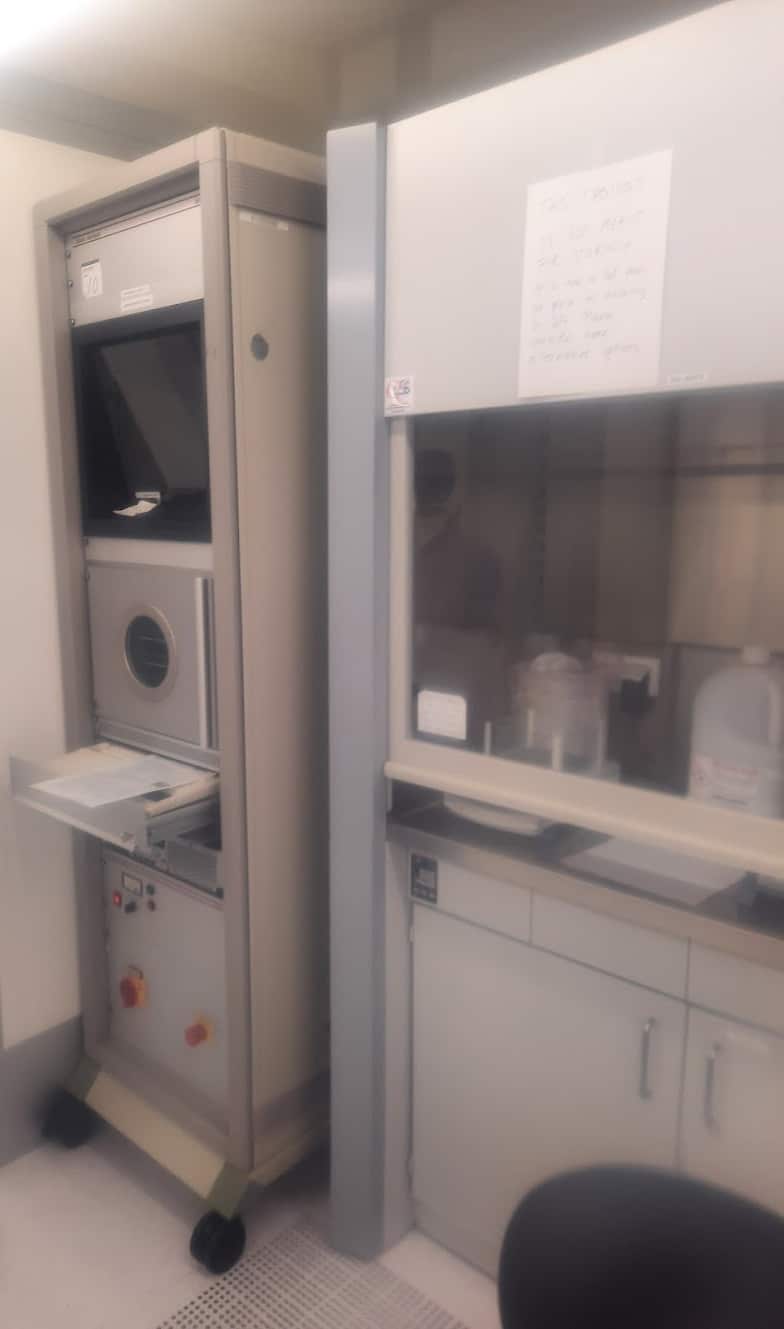
Diener Tetra-30-LF-PC is a plasma system is used mainly for surface treatments and cleaning of various substrates with O2-plasma. This plasma system works in mode opposite to RIE and therefore it does no bombard surface with ions. In general the system can’t be used for etching because it is very slow and etch rate is non-uniform. It is, however, ok to modify surface chemistry or to remove atomic level organic contaminations. In some instances system can be used to degas PDMS for example.
Details
Location:
Tampere University (TAU), Tampere
Contact person:
Jukka Viheriälä (Tampere)
Info:
Diener Tetra-30-LF-PC is a plasma system is used mainly for surface treatments and cleaning of various substrates with O2-plasma. This plasma system works in mode opposite to RIE and therefore it does no bombard surface with ions. In general the system can’t be used for etching because it is very slow and etch rate is non-uniform. It is, however, ok to modify surface chemistry or to remove atomic level organic contaminations. In some instances system can be used to degas PDMS for example.
Specifications
The system specifications and allowed materials are stated below.
Before proceeding with a process, consult the equipment responsible on the material compatibility with the system and creation of a new recipe.
- The compatibility of the intended process an materials with the system has to check to avoid system contamination or breakdown.
- New recipies can be created only by trained personel. Wrong recipe might not be fuctional or could damage the sample or the system.
- Any non-standard process needs an approval from the equipment responsible.
- Standard process refers to processes used standardly in our facilities. Processes previously not used in our enviroment fall to the cathegory of non-standard.
Operating parameter ranges
| Maximum sample size | 5 pcs of sheets up to approximately 200x300mm^2 |
| Total gas flow | 10 – 200 sccm |
| Pressure | 0.1 – 5 mbar |
| RF power | 10 – 1000 W but system may fail to reach lowest and highest point. Typically 100-750W |
| Temperature | Room temperature, substrate does not heat up significatly |
| Etch duration | Typically 1-10min |
Compatible materials
If you wish to use materials not listed, consult the equipment responsible.
| Process gasses | O2 |
| Allowed materials for plasma treatment |
|
| Forbidden materials for etching |
|
| Allowed processes |
|
Training
The training of all new users is conducted by the equipment responsible. Independent training or use of the system is not allowed unless otherwise agreed with the equipment responsible. Training is also required for personnel that has used similar systems in other facilities.
Requirements:
For a user to receive training in the use of the plasma system, they a required to have:
- Frequent and present need
- The system should be used regularly and taken into use soon after training in order to maintain the level of competence of the operator. However for this system more relaxed requirement is possible because both system and its use is very simple.
- Plan of the intended use: materials, process gasses and parameters
- Basic help with the process details can be provided to ensure proper operation of the system: https://tuni.sharepoint.com/sites/TG-microandnanofabrication/SitePages/Process-Training.aspx
- Understanding of the basic principles of plasma etching processes (be aware of the involved process mechanisms)
- Complete training in the safe and proper use of the system will require short 1 h training and support during first uses of the system.
Training requests:
Contact the equipment responsible (Jukka Viheriälä), email preferred.
- Provide the information stated in the requirements.
- Make the initial inquiry well in advance.
- Depending on the equipment availability and and the schedule of the equipment responsible there might be some delay in training.
Process and system problems
In case of irregularities in the system operations, stop using the system and contact the equipment responsible.
In case of imminent/catastrophic danger/system failure contact Laboratory Chief (Ilkka Hirvonen).
Standard operating procedure (SOP) for the system can be found at the end of this page. Note that the document is intended to be used as a support and it does not replace face-to-face training.
Send an enquiry
"*" indicates required fields